Poverty is a real problem here in the United State and in the world at large. According to some estimates, 1.4 billion people in the earth suffer from extreme poverty – a condition that leaves them surviving on less than $1.25 a day. If these numbers represent reality, that means that roughly one in five human beings live on $1.25 or less a day.
To give this level of poverty some perspective – $1.25 turns into $456.25 a year for an individual. If we add up all 1.4 billion $465.25s we will find that at the maximum these 1.4 billion people live on is $623.75 billion year. We just recently passed a $700+ billion “bail-out” package for Wall Street. That is how much money 1 in five of your human brothers and sisters live on.
But I didn’t want to talk about world poverty today or even about the United States economic policies. Instead, I wanted to talk about how we in America define poverty in a bureaucratic, statistical sort of way. This is very different from how the average Joe “six-pack” might define it. You see, I am sure that each person, class, and region has its own definition of what we might call “poverty.” I like to think of this as the level of living at which our friends, neighbors, or relatives would classify us as poor. This standard is generally fairly arbitrary and probably has more to do with social status than about actual poverty. Let us call this “social poverty.”
Here in the US we define real poverty as anything below the US poverty threshold. As of 2007, the poverty threshold for a single person under the age of 65 was $10,590. That amounts to $29.01 a day – the equivalent of roughly 4.5 hours of work at the federal minimum wage ($6.55 per hour). If you earned less than that amount last year and you are the only member of your household, you are considered poor by the US Census Bureau – congratulations!
Being the sort that likes to know the beginning of things and how they work I got to questioning how this whole poverty threshold idea got started. And how do you calculate what your family’s poverty threshold is? The following is what I discovered.
History of the Poverty Threshold
It all begins with a female Polish immigrant from the Bronx and rich white dude from Texas. The girl is a scholar by the name of Mollie Orshansky. She had a long career as a government bureaucrat which eventually found her doing statistical work for the Social Security Administration (SSA) in 1958. Her task was to analyze if people in America made enough money to support themselves and their families.
Five years later she reported her findings in a paper and the Orshansky Poverty Thresholds were born. In her analysis, Orshansky relied heavily on calculations that determined the income required to provide a family with a nutritionally adequate diet. This formed the center of her Threshold. What was important about her calculations was that it measured poverty in an absolute fashion and did not take into consideration geographic subtleties.
What I mean by that is that the poverty threshold for a single male living in urban New York City was the same as the single male living in rural Alabama. This made her calculations simple and easily used by a government for any “war on poverty” that might just happen to come up.
Enter rich white guy from Texas. This rich white guy from Texas just happened to become president when another rich white guy from Massachusetts got shot in Texas. These were not happy times.
Needless to say, LBJ, you know – that rich white guy from Texas – didn’t like poverty very much so he declared war on it in 1964. But he was stuck on how to tell if he was actually winning his war or if he was getting stuck in another proverbial quagmire (like Vietnam). He probably read a little, or at least his cabinet members did, and he came across Orshansky’s threshold and he said, “By Jove, we have it.” War was declared and the Orshansky Poverty Threshold was tweaked a bit and turned into the Poverty Threshold.
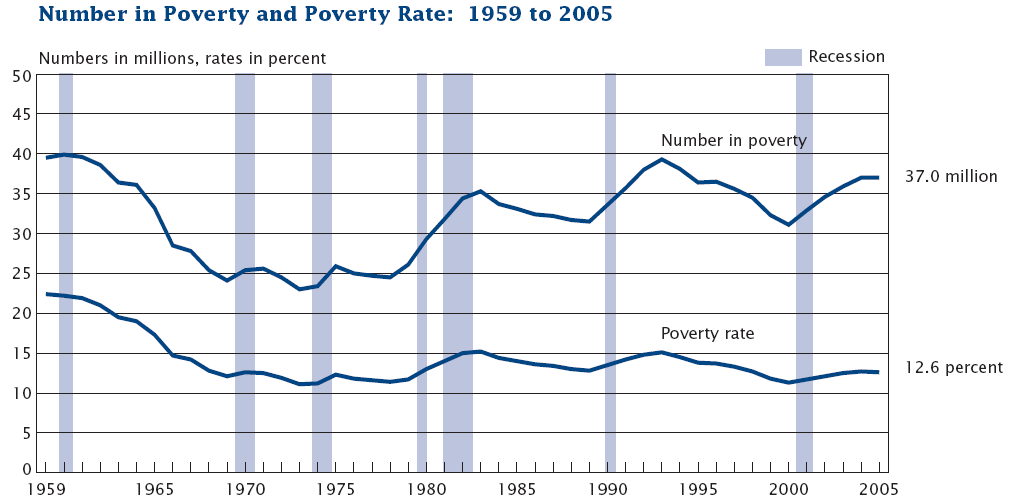
Here is a handy graph that shows both the rate of poverty in the US and the total numbers of people in poverty:
Finding Your Family’s Poverty Threshold
In all, there are 48 different possible thresholds depending on your age and family size. These numbers are updated annually based upon changes to the Consumer Price Index for All Urban Consumers (CPI-U) so they try to remain as up-to-date as best as they can. But there is some dispute over how well the Poverty Threshold actually measures poverty on a case by case basis.
Just for fun let’s take a look at where we each land on this measure of statistical poverty. If you can’t read the numbers, click on the photo and you will go the US Census Bureau website where I lifted the chart:
My family of soon to be three would be considered in poverty if our household income was below $16,689. I currently make a little north of double that amount. So the wife and I are safe from being a statistic on the US Census Bureau’s poverty report. Yippe!
If we did make less than $16,689 all the members living in my household would be considered in poverty – even my infant son.
How does your family stack up? Do you feel like you are poor but don’t classify as statistically poor? Do you technically classify as “poor” but certainly don’t feel that way?
Developing skills and infrastructure that will help my family live well is an important part of my job as a husband and father. Skills are important because I can leverage them for wages or for meeting my family’s needs directly. Similarly, by developing a robust infrastructure I will be able to assist my family in the daily business of living – helping maintain an adequate supply of food, shelter, clothing, and technology. This is my major role as a leader in my family.
There are a host of skills that are useful for living. Each of them can fall into the four basic categories I mentioned above with a less essential but equally important fifth category – entertainment. The skills that fill each category are things like the ability to grow food, farm animals, build houses, mend ruffing, make shirts, sew socks, keep a gun, fix a car, play a guitar, or write poetry. Each skill is useful both to my family as well as being potentially useful to another individual or family.
Some of the skills I mentioned above are harder to develop than others – they require more time, acumen, or resources/infrastructure to learn properly or effectively. For example, it is much harder to learn how to hunt whales than it is to learn how to hunt deer. Even though the mental discipline is probably essentially the same, the resources and the time needed to hunt a whale are much greater than the time and resources needed to hunt a deer (boat, harpoons, crew vs. gun, bullets, deer urine). The barrier for entry is relatively low in the case of the later while extremely high in the case of the former. Because of this, it is my expert opinion that a novice deer hunter is much more likely than a novice whale hunter of landing a kill and bringing home the bacon.
This example also sheds light on the fact that many times the biggest barriers to acquiring a skill are infrastructure and time. You can’t learn to farm unless you have access to land. You can’t learn to play like Mozart unless you have access to a piano. You can’t learn to bake unless you have access to basic baking ingredients and an oven. And you can’t do any of them if you don’t have the time. I think we all get this point, but I mentioned these because I want to underscore just how important infrastructure is to the core needs of a family. Without an adequate supply of it a family limits its skill acquiring potential and its ability to survive/thrive.
Developing Skills, Acquiring Infrastructure
It is becoming my new goal to acquire as many useful skills and as much portable, useful infrastructure as I possibly can for my family. I only want portable, useful infrastructure right now because I am not currently “settled” in a single location as of yet. My wife and I have plans to move around a bit within the next year after our baby comes (November 10 is the due date) and I personally don’t want to be bogged down by purchasing a tractor or other large, bulky, and expensive tools (can you say table saw?). As of right now the most important infrastructure needs are met:
- Transportation – 1995 Toyota Corolla and 198? Panasonic DX 2000 road bike
- Communication – Wife’s Cell Phone
- Computer – Dude, you’re getting and HP
- Information Access – Internet, Library Card
- Stable Bank Account – ex. WaMu On-line Savings
- Credit Account – Now Savings Account Holder, Chase
- Clothing – Years and Years Worth
- Cooking Gear – Yes!
I don’t see any immediate needs to add anything to this basic infrastructure as of yet, but you never know what might happen between now and the indeterminate future. Right now I think I should focus more on developing a set of skills.
The reason for this focus is that my useful skills are a little lacking. Aside from my tremendous ability to do a whole heck of a lot of nothing and play tons and tons of video games, I can’t really say that I know how to do much that is particularly useful to very many people. At my current job I just essentially do what anyone with half a brain could be able to do. My level of experience working there isn’t what I would call sufficient to consider myself indispensable either. I am essentially a very replaceable cog in a very small sub-machine that is part of a much larger super-machine. I am Jack’s totally dispensable career.
In an effort to increase my money making skills and to supplement my income I have been trying my hand at a few different things. Many of them occur in the online world – things like blogging, internet marketing, and SEO – and I have had some very limited success pursuing these avenues. I am certainly not making money hand over fist by any means, but I feel like I am starting to catch on and make some solid gains. By the end of the year I hope to be making an extra $100 a month from these skills, and with that I am extremely happy.
This growth in revenue is like giving myself a 5.3% raise in take home pay.
In addition to developing these money making skills, I am also trying to get some useful skills under my belt that may not make money, but sure do save it. I’ve tried my hand at some basic auto repair, bike maintenance, cooking – but auto repair scares the be-jesus out of me, bike maintenance has been really easy, and cooking is mainly done by my wife who is way better at it than me anyway.
There is one skill that both my wife and I have wanted to try our hand at but have been unable to until recently due to a lack of infrastructure – garden. At our apartment we did not have a spot of land to try our green thumb. We didn’t even have a balcony where we could put potted plants due to fire codes. But now that we have moved out of that apartment and temporarily in with my dad we have plenty of space to start turning soil to good use.
Fortunately for us, California has a nearly year round growing season. I’m not entirely sure if we are going to be able to make it for the fall planting season since we are getting ready for our baby to enter the world, but I think we are going to give it a good college try. We really want to get some homegrown strawberries going.
So in the next month or two we are going to be hitting the yard and getting acquainted with the fine art of “container gardening.” This is exactly what it sounds like. We are going to try to grow a garden in pots in the back and front yard of my dad’s house. This garden will exists solely to provide food to my family and to teach us how to grow things that you can eat. Neither my wife nor myself have any experience with this type of thing so there is probably going to be a bit of learning curve.
I am not expecting to have very much success with the garden for at least a season or two. I think that by setting the bar low I will be pleasantly surprised if things go well and not too terribly depressed if things go as I expect. Low expectations are a win-win!
I’m not to sure what other skills or infrastructure to try and start acquiring after that – does anyone have any suggestions?
Amidst the financial turmoil of the past several days my banking institution of choice has failed and I have been forced into an experiment in water conservation like none other – taking a 6 litre shower. According to the first page returned for the Google search “how much water does a typical shower use” a typical shower consumes anywhere from 15-30 gallons of water. If you do the conversion, that equals 68.25-136.5 L. By only using 6 L of water I am 91% atypical – meaning that I use only 7% of the low end of the typical spectrum.
What has caused this massive overhaul in the amount of water that I consume on a daily basis? The shower in my office building is broken. Stupid broken shower. Or should I say awesome broken shower that “has realigned my perception?”
It truly has given me a whole new appreciation for running water and the magical shower heads that fill our homes, beach bathrooms, and work cleaning stations. Three days of showering from a bottle has freed my mind and body from the comfort of having hot water water to clean the manly musk that wafts from my body as I walk. Standing in the dark corner of the downstairs bathroom with nothing but two 750 ml water bottles that I fill in the downstairs sink, a bar of soap, and a bottle of shampoo has cleared away the cobwebs of waste and opulent wealth that have been clouding my thinking for these 25 years. Necessity has proven what comfort has so long resisted – getting clean doesn’t have to be comfortable, it just has to be efficient.
The Shower Saga Begins
The first day of my 6 L shower was terribly miserable. I was taken completely by surprise. I wasn’t prepared for anything. Instead of having water bottles pre-filled I was forced to live on the trickle from the shower head alone. It took forever to get my body sufficiently wet and forever again to get the soap sufficiently off. In fact, I think I got more of the soap off my body from sweating on bike commute home than I did in the shower that day. Not fun.
The next day I was a little more prepared, but got tricked by the appearance of a properly working shower head. There was just enough of a flow of cold water for me to get my body wet and soap up before the water began to trickle like it did the day before. This time I used an empty 750 ml bottle to collect the trickle from the shower and used this to wash off the soap. It was much more efficient and effective at removing the soap from my body, but still nothing to tell your mom about.
“Perfecting” The New Shower System
Then the day after that I finally got the system down pretty good, bringing two bottles with me and filling each up before entering the shower. The first bottle was used to wet down. Then I soaped up. Then I rinsed with the second bottle. The second bottle wasn’t quite enough to wash all the soap away, so while I was soaping up I filled the bottle that I had used to wet down. It wasn’t completely filled at this point, but it was sufficiently so to get the rest of the soap off my body. I was the cleanest I have been in three days at that point.
Still having to wash my hair I dried off my body and got some clothes on to be appropriate in the public restroom. I filled another bottle (this is the fourth) to wet down my hair and then shampooed. A fifth bottle washed off my hair. Not feeling like the pressure from poring was enough to wash the rest of the shampoo away I stuck my head under the sink and turned on the facet for a few moments. This could have used more than 2.25 L of water, but I think it could be close.
The whole process took about 10 minutes and only consumed about 6 L of water. w00t.
The Future of Steward’s Showers
This has been a pretty positive experience for me and I plan on continuing this method of showering even after the shower gets fixed at work. Heck, I might even employ some of these techniques at home if I would actually shower there. Having the shower fixed and flowing will make it so that I don’t have to wait so long for my bottle to get filled when I am actually in the shower – possibly making showering very quick as well, which would be nice for my time.
I’m sure there are tons of positives in taking short showers that use less resources, but I’m not too concerned about those right now. Instead, I am excited that I have finally broken the habit of taking long, hot showers. It makes me happy.
We all want a better life for our children. The evidence for this is everywhere and often makes its way into advertising campaigns of all varieties. Where I live in California we have commercials about saving our children from energy crises. There is GPS for kids that will help us locate our children in the off chance that they get snagged by someone other than their estranged relative. Toys keep getting bigger and better as we get our children cell phones, laptops, gaming consoles, and extra curricular activities that would have made us the happiest kids in the world 10-15 years ago.
A fellow personal finance blogger brought up an interesting concept that those who want to give their children a better life might want to give some thoughtful consideration – helping your child get rich.
In this post, the Silicon Valley Blogger praises the power of compound interest (others might call it the magic of compound interest, but I digress). She writes:
While it may be late for some of us to maximize our lifetime investment potential, it may not be the case for our children. If you start an investment program early enough, especially for your kids, you could help them acquire a million dollars by the time they’re 40. Investing even with the simplest of portfolios can help get you to that point.
The basic idea behind it all is that a small amount of money invested at an early enough time will produce very large returns over a large enough time horizon. If I invested $30,000 for my soon to be born son and averaged a 5% return after taxes this money would become $211,199 by the time Junior is 40. If he were to contribute an additional $10,000 a year once he turns 22 that sum would jump to $531,859. That is a lot of money.
But pondering this scheme has got me questioning whether it would even be a good idea to even give my child this type of wealth. Will it really make his life better? Will it teach him to work hard and to serve the greater good? Will it engender a love for others that is authentic and moves him toward action? Or will it make him a consumer, buying things he doesn’t need – making his life meaningless, shallow, and empty? Am I setting him up to excel in life or to waste it away?
Better Than A Millionaire – Giving Your Child the Gift of Giving
In thinking about how to definitely avoid turning my precious child into a mindless, heartless, and soulless consumer I think I came up with one of the best ideas I have ever had – teach my child to give their unearned, acquired wealth away. After all, it is better to give than to receive – right?
The idea behind this is simple: instead of passing that wealth along to your child as their personal assets, teach and train them to manage it like they would a trust fund for a non-profit organization. When they come of age instead of worrying how they are going to spend the 200k you saved for them you will be filled with the joy of seeing your child full of joy with meeting the basic life and infrastructure needs of thousands of people the world over. They could do this in one lump sum, making an organization that supplies food to those affected by regional instability (read war, famine, or disease) a very happy organization. Or they could continue to grow and manage the fund, giving a portion of the profits away while reinvesting another portion and even adding additional money to grow the fund’s giving potential. Talk about giving to the max!
They could then go from there and give the fund over to their children who could add to it and grow it and give even more away, who could give it to their children, who could give it to their children, who could give it to their children, and on and on it goes. The amount of wealth that could be turned into improved lives for individuals and communities in need the world over is impressive – and it can all begin with you.
The Price of Privilege – Making the Most of America’s Acquired Wealth
I am a firm believer that for those who have much, much is required. American’s, with their amassed wealth and technology, are among the richest in the world. Because of this I feel that we can make a significant impact on the world around us simply through the dissemination of our wealth and technology to those that really need it, the poorest of the poor. This needs to go on at a government level, but I think that the vast majority of it should be done by individuals for the sake of other individuals. Actual people starve to death every single day at the rate of about 17 per minute.
None of us would let a starving neighbor die if we knew that something we could do could help. Living in the age of globalization is bringing into sharp relief that fact that all mankind is now my neighbor. My energy use not only will help avoid rolling brown-outs in my southern Californian home, but it also can affect the Arctic Inuit’s way of life. I am responsible for my actions and their impact on humanity at large.
This is a message my children need to hear loud and clear from me, and what better way to teach it than to create some wealth for us to manage and improve our world together. I will avoid fostering mindless, heartless, and soulless children by doing the exact opposite – giving them the resources to make their creative problem solving a reality, the compassion to see all men as their equal, brother, and friend, and I will teach them that the quality of a life is measure in more than houses and cars and iPods and comforts – it is measure in life freely given.